


December 2025
Mission Statement
Dalkey School Project National School strives to create a happy, friendly, inclusive, educational environment where each child is unique and valued. We are a welcoming school where diverse talents are appreciated and the school community works together respectfully.
To this end, Dalkey School Project prioritises the wellbeing of its students by providing a safe and nurturing environment at all times.
Dalkey School Project has taken a number of measures to create a coping, supportive and caring ethos in the school. The school has also formulated a number of policies and procedures to be followed with a view to ensuring the physical and psychological safety of staff and students, both in ordinary time and in the event of a critical incident.
Rationale
A critical incident policy is necessary to:
- Recognise the reality of life where bad things happen,
- Respond not React. Empower the Dalkey School Project NS community to deal effectively and compassionately with such incidents allowing space for the whole school community to respond to events in an organised, supportive manner. In this way the school community can return to ‘normal’ as soon as possible.
What is a Critical Incident?
As per DES / NEPS guidelines, Dalkey School Project recognises a critical incident to be “an incident or sequence of events that overwhelms the normal coping mechanism of the school and disrupts the running of the school”. Critical incidents may involve one or more pupils, staff, the school, or our local community. Types of incidents might include:
- The death of a member of the school community through sudden death, accident, terminal illness or suicide.
- Outbreak of disease or major illness in school or community.
- Serious injury sustained by a member of the school community as a result of violence on or off school grounds.
- A threatening or violent intrusion into the school.
- An accident / tragedy in the school or wider community.
- Serious damage to the school building through fire, flood, vandalism, etc.
- The disappearance of a member of the school community.
- Unauthorised removal of student from school.
Aim of DSP Critical Incident Policy
Recognising that the key to managing critical incidents is planning, Dalkey School Project has developed this Critical Incident Management Policy and accompanying plan. Our hope is that, in the event of an incident, this will help staff to respond quickly and effectively and to maintain a sense of control.
Creation of a coping supportive and caring ethos in the school
We have put systems in place to lessen the probability of the occurrence of an incident and to help build resilience in both staff and students, thus preparing them to cope with a range of life events. These include measures to address both the physical and psychological safety of both staff and students.
Physical safety:
The following policies and strategies have been put in place in order to maintain the physical safety of all members of the school community.
- Health & Safety (please refer to the Health and Safety policy for further details).
- Evacuation plan formulated.
- Regular fire drills occur.
- Fire exits and extinguishers are regularly checked.
- The Fire Alarm is serviced regularly, at least once a year.
- Visitors to the school are advised to report to the school office.
- Pupils are not released into the care of persons unknown to school staff without checking with a parent/ guardian.
- Pupils are reminded of playground rules by staff at regular intervals in the context of our School Code of Behaviour.
- Pupils are adequately supervised at all times especially during physical activity and break times. An appropriate number of teaching / ANA staff supervise the children during break time.
- First Aid box maintained and kept in:
a) Secretary’s office b) Upstairs resource room; Room 4 c) Downstairs shared area; Area 9
Psychological Safety
Dalkey School Project is dedicated to creating a warm, welcoming environment where every child feels safe, supported, and heard. We believe that each student should feel comfortable expressing their thoughts, feelings, and concerns— knowing that they are valued and respected. Our school is a place where we encourage the children to share the challenges they face, whether academic, social, or emotional, and seek the help and support they need to grow and thrive.
The following aims to support and ensure the psychological wellbeing of our pupils:
- Our Play Therapy Programme plays a huge role in the wellbeing of our children. It helps children to process difficult life events and is a safe outlet for their emotions. It also helps children to regulate their emotions and bodies while reducing anxiety and stress. The children become more self-aware and find their own path to restoring self-control. Through imaginative play, children learn to think creatively about how to handle different situations. By promoting emotional healing and fostering social growth the child can be more open to learning. Children grow and thrive.
- Forest School is particularly important to wellbeing. It helps the children develop a sense of awe and wonder as well as meeting their regulation and confidence needs. Forest School is our long-term outdoor education programme, delivered by trained practitioners in a natural setting. Typical activities include games, storytelling, natural art, climbing trees, using tools for crafts, exploring nature and quiet reflection. As children express curiosity and delight in their surroundings, oral and written language become vital means of expression.
- The Learn Together Curriculum promotes all key competencies of the Primary Curriculum framework, it particularly supports the development being well.
- Advocacy work to highlighted the need for adequate supports and resources for children.
- SPHE is an integral part of the school curriculum and addresses issues such as grief and loss, communication skills, stress and anger management, conflict management, problem solving, help-seeking, resilience, bullying, decision making, and alcohol and drug prevention. Promotion of mental health is an integral part of this provision.
- The Stay Safe programme is taught in its entirety to all relevant classes (SI, 2nd, 4th 6th classes).
- Looking at our School 2022
- Wellbeing Policy Statement and Framework for Practice
- The school has a clear policy on bullying and deals with bullying in accordance with this policy; Bí Cineálta Policy (refer to policy for futher details).
- Child Protection policy & Child Safeguarding policies are reviewed annually.
- Staff have completed Oide Child Protection Training for the new Child Protection Procedures 2025
- Staff are familiar with the Child Protection Guidelines and Procedures and details of how to proceed with disclosures.
- Staff have completed ‘Introduction to Children First’ online training programme.
- Programmes such as Friends for Life, Weaving Wellbeing, Zones of Regulation, Restorative practices are taught in the school.
- Staff are informed of difficulties affecting individual students and are aware of and are vigilant in identifying their needs.
- Staff have access to books and resources on difficulties affecting the primary school child.
- The school has developed links with a range of external agencies including Carmona Services, HSE, NEPS, Enable Ireland, CAMHS, Túsla Child and Family Agency.
- Information is provided on mental health in general and such specific areas as signs and symptoms of depression and anxiety.
- National Educational Psychological Service (NEPS) Guidelines, Tips and Handouts for Parents and Teachers
- Emotionally Based School Avoidance (EBSA) Resource Pack
- Inputs to students by external providers are carefully considered in the light of criteria about student safety, the appropriateness of the content, and the expertise of the providers. See DES Circulars 0042/2018 (Primary)
- There is a care system in place in the school using the “Continuum of Support” approach, which is outlined in Special Educational Needs: A Continuum of Support Guidelines for Teachers
- Students who are identified as being at risk are monitored by the principal, class and support teachers. Concerns are explored and the appropriate level of assistance and support is provided. Parents are informed, and where appropriate, a referral is made to an appropriate agency.Staff use the publication Behavioural, Emotional and Social Difficulties: A Continuum of Support Guidelines for Teachers
- Staff also use the publication Understanding Behaviours of Concern and Responding to Crisis Situations Guidelines for Schools in Supporting Students
- NCSE Relate: A Regulation-First Approach to Reframing Behaviour and Supporting Student Engagement and Participation
- Trauma Informed Approach: The Stress Factor, Getting the Balance Right A NEPS e-Learning course for schools
- Staff are informed about how to access support for themselves; Employee Assistance Service
Critical Incident Management Team
Dalkey School Project has set up CI Management Team in line with best practice and will maintain this team in future. The members of the team were selected on a voluntary basis and will retain their roles for at least one school year. The members of the team will meet once a year to review and update the plan. Each member of the team has a Red Folder with relevant materials to be used in the event of an incident.
Roles
Key roles have been identified and assigned as follows:
| Role | Name | Phone |
| Team leader | Clodagh Robinson | |
| Garda liaison | Clodagh Robinson | |
| Staff liaison | Fiona O’Donohue Maryrose Leeson | |
| Student liaison | Deborah Reynolds Amy Wall Rebecca Sutton | |
| Community liaison | Maryrose Leeson Cathy Maguire Eimear McGran | |
| Parent liaison | Una Kennedy Rebekah Connolly Brian Mannion | |
| Media liaison | Clodagh Robinson Maryrose Leeson | |
| Administrator | Gillian Hudson Aoife O’Driscoll |
In the event of a critical incident, the responsibilities of each role-holder will be as follows.
Team Leader: Clodagh Robinson
► Alerts the team members to the crisis and convenes a meeting.
► Co-ordinates the tasks of the team.
► Liaises with the Board of Management and Department of Education and Skills, I.N.T.O., NEPS / relevant agencies ► Liaises with the bereaved family.
Garda Liaison: Clodagh Robinson
► Liaises with An Garda Síochána where necessary.
Staff Liaison: Fiona O’Donohue, Maryrose Leeson
► Leads meetings to brief staff on the facts as known, gives staff members an opportunity to express their feelings and outlines the routine for the day.
► Advises staff on the identification of vulnerable students.
► Is alert to vulnerable staff members and makes contact with them individually.
► Provides materials to staff from the Red Folder.
► Keeps staff updated as the day progresses
► Advises them of the availability of EAS (Employee Assistance Programme 1800 411 057) and gives them the contact number
Student Liaison: Deborah Reynolds / Amy Wall / Rebecca Sutton
► Liaises with other team members to keep staff and students updated with information and progress.
► Alerts staff to vulnerable students.
► Provides materials for students from the Red Folder.
► Maintains Student Contact record (on google drive)
► Looks after set-up and supervision of quiet room where agreed.
Community Liaison: Maryrose Leeson/ Cathy Maguire / Eimear McGran
► Liaises with agencies in the community for support and onward referral.
► Updates team members on the involvement of external agencies. ► Co-ordinates the involvement of these agencies.
► Maintains up to date lists of contact numbers of o Key parents, such as members of the parents’ council.
o Emergency support services and other external contacts and resources.
► Reminds agency staff to wear name badges
Parent Liaison: Una Kennedy / Rebekah Connolly/ Brian Mannion
► Facilitates ‘questions and answers’ meetings. ► Meets with individual parents.
► Provides materials for parents from the Red Folder.
► Visits the bereaved family with the team leader.
► Arranges meetings if held.
► Manages the consent issues in association with the agreed school policy
► Ensure the sample letters are prepared and available on the server
► Set-up rooms for meetings with parents
► Inform all staff to maintain a record of parent contact (on google drive)
Media Liaison: Clodagh Robinson / Maryrose Leeson
► In preparing for the role, the media liaison person will consider issues that may arise during an incident and how they might be respond to (e.g. students being interviewed, photographers on the premises, etc).
► In the event of an incident, they will liaise where necessary with the Communications Section in the DES.
► Will draw up a press statement
► Give media briefing and interviews as agreed by BOM
Administrative Tasks: Gillian Hudson / Aoife O’ Driscoll
► Maintenance of up to date lists of contact numbers of
■ Parents or guardians
■ Teachers
■ Emergency support services
► Takes telephone calls and notes those that need a response
► Ensures template are available on the schools IT system letters ► Prepares and sends out letters, emails and texts ► Photocopies materials as needed.
► Maintains records.
Record Keeping
In the event of an incident each member of the team will keep detailed records of phone calls made and received, letters sent and received, meetings held, persons met, interventions used, material used etc. This will be recorded in the relevant form on google drive. The school secretary will have a key role in receiving and logging telephone calls, sending letters, photocopying materials, etc.
Letter to Parents
The Principal will prepare a brief, written statement to include:
► The sympathy of the school community for the affected/bereaved family
► Positive information or comments about the deceased/injured person(s)
► The facts of the incident
► What has been done
► What is going to be done
Confidentiality and good name considerations
The school has a responsibility to protect the privacy and good name of the people involved in any incident and will be sensitive to the consequences of any public statements. The members of the school staff will bear this in mind, and will ensure that pupils do so also. [For instance, the term ‘suicide’ will not be used without the consent of the family involved or until it has been established categorically that the person’s death was a result of suicide. The phrases ‘tragic death’ or ‘sudden death’ may be used instead.]
Critical Incident Room
| Critical Incident Rooms In the event of a critical incident, the following rooms are designated for the indicated purposes | |
| Room Name: | Designated Purpose: |
| Main room for meeting staff | |
| Meetings with students | |
| Meetings with parents | |
| Meetings with media | |
| Individual sessions with students | |
| Meetings with other visitors | |
It has been agreed, that as we are a small school with limited space, we would not make decisions about designated rooms in advance of a Critical Incident.
Short term actions – Day 1
| Task | Name |
| Gather accurate information | |
| Who, what, when, where? | |
| Convene a CIMT meeting – specify time and place clearly | |
| Contact external agencies | |
| Arrange supervision for students | |
| Hold staff meeting | All staff |
| Agree schedule for the day | |
| Inform students – (close friends and students with learning difficulties may need to be told separately) | |
| Compile a list of vulnerable students | |
| Prepare and agree media statement and deal with media | |
| Inform parents | |
| Hold end of day staff briefing |
Medium term actions – (Day 2 and following days)
| Task | Name |
| Convene a CIMT meeting to review the events of day 1 | Team leader |
| Meet external agencies | |
| Meet whole staff | |
| Arrange support for students, staff, parents | |
| Visit the injured | |
| Liaise with bereaved family regarding funeral arrangements | |
| Agree on attendance and participation at funeral service | |
| Make decisions about school closure | BOM |
Follow-up – beyond 72 hours
| Task | Name |
| Monitor students for signs of continuing distress | Class teachers |
| Liaise with agencies regarding referrals | |
| Plan for return of bereaved student(s) | |
| Plan for giving of ‘memory box’ to bereaved family | |
| Decide on memorials and anniversaries | BOM/Staff, parents and students |
| Review response to incident and amend plan | Staff/BOM |
Consultation and communication of this policy and plan
All staff were consulted and their views canvassed in the preparation of this policy and plan.
Our school’s final policy and plan in relation to responding to critical incidents has been presented to all staff. Each member of the critical incident team has a personal copy of the plan.
All new and temporary staff will be informed of the details of the plan by Deborah Reynolds. The plan will be updated annually – next review will be March/April 2026.
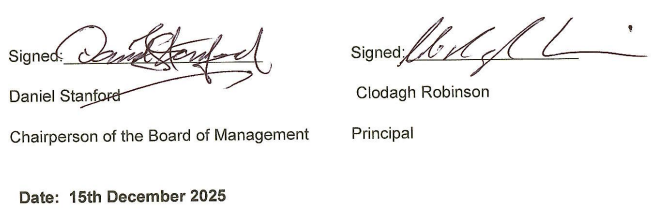
Date: 15th December 2025
EMERGENCY CONTACT LIST
| AGENCY | CONTACT NUMBERS |
| Board of Management Chairperson Daniel Stanford | |
| Garda Blackrock Dun Laoghaire | 01-6665200 01-6665000 |
| Hospitals National Children’s Hospital, Tallaght | 01-4142000 01-2806901 |
| St Michael’s Hospital, Dun Laoghaire St Vincent’s Hospital | 01-2214000 |
| Fire Brigade Kill Ave, Dun Laoghaire | 01-2801904 |
| Local GP: Dr. Padraig Doherty | 01-2855520 |
| HSE Dun Laoghaire (Dental) Dun Laoghaire (other) Community Services Children & Families, Civic Offices, Bray | 01-2843579 01-2808471 01-2365200 01-2744200 |
| NEPS resources for critical incidents: https://www.gov.ie/en/service/5ef45c– neps/#critical–incidents NEPS Dublin Region (Contact for NEPS support) NEPS, Floor 4, Metropolitan Building James Joyce Street, Dublin 1, D01 KOY8. NEPS Psychologist Ms. Nicola Brennan | Tel: (01) 8650400 |
| Community Care Team Loughlinstown Killiney Primary Care Team | Tel : 2822122 / 2822218 |
| Child and Family Centre | 1800 700 700 |
| Child and Family Mental Health Service (CAMHS) Lucena clinic, Dun Laoghaire | 01 2809809 |
| School Inspector Caitriona Ni Bhriain | Caitriona_nibhrian@education.gov.ie |
| INTO | 1850 708708 |
| Clergy Sallynoggin Parish St Paul’s Church of Ireland, Glenagery | 01 2854667 07-2801616 |
| Employee Assistance Service | 1800 411 057 |