

December 2025
Introductory Statement and Rationale
In Dalkey School Project (DSP) we strive to create “a happy, safe, inclusive and nurturing environment where…all members of the school community can grow, develop and achieve their full potential”. This assessment policy supports this mission statement by providing a framework for pupils to receive early, targeted intervention, thereby helping them to overcome any barriers to learning they may face and so achieve to the best of their abilities.
In addition, this policy acknowledges the important contribution that parents and pupils can make in the child’s learning journey.
In DSP, assessment plays a crucial role in our School Self-Evaluation (SSE), as it helps create a reflective, holistic approach to understanding and improving both teaching and learning. Assessment in DSP is not just about tracking academic achievements; it is a continuous journey of understanding each child’s unique growth. It’s about gathering insights from every moment of learning, reflecting on the whole child, and using what we learn to create a learning environment that nurtures their mind, heart, and spirit. This means considering not only their academic progress but also their social development, emotional well-being, and creative expression.
Relationship to characteristic spirit of the school
Dalkey School Project National School strives to create a happy, friendly, inclusive, educational environment where each child is unique and valued. We are a welcoming school where diverse talents are appreciated and the school community works together respectfully. We cooperate to have a peaceful and safe atmosphere in which to learn and teach. We nurture each person’s potential and aspire to excellence. Assessment activities used in this school will contribute to pupil learning and development by gathering relevant information to guide each pupil’s further learning (assessment for learning) and by providing information on pupils’ achievement at a particular point in time (assessment of learning).
Student Voice
Student voice empowers our children to own their progress, reflect on their strengths, and better understand their learning needs. Every child has the right to be heard, to share their thoughts, feelings, and ideas about their learning experiences. This right is not just individual—it belongs to every child, and to groups of children, because their voices are key to shaping the environments in which they learn and grow.
By listening to students, observing their experiences, and offering meaningful feedback, we can adapt our approach to ensure that each child feels supported and valued in every aspect of their learning. Assessment becomes a tool to help children grow in a personalized and holistic way, empowering them to discover their strengths, navigate challenges, and celebrate their achievements—whether big or small. It’s a process that puts the child at the centre, helping them feel seen, heard, and equipped to thrive in all areas of life.
Role of Parents
Parents/guardians also have an important role in sharing valuable information from a point of view outside of the school experience. This supports the democratic ethos of DSP in which we seek to foster genuine partnership with parents/guardians regarding their child’s education. Effective schools always take account of the influence of the home on children’s learning and they build on the experience children bring to the school. In the school, the teacher plays a central role in using that experience to help identify children’s learning needs and to provide the learning experiences that will best promote their development.
Relationship between Assessment in DSP & Wellbeing Policy Statement and Framework for Practice
- Active Engagement in Learning: Encouraging students to reflect on their work and set personal goals through regular check-ins or learning portfolios fosters engagement, a sense of agency, and an awareness of how their progress connects to their well-being.
- Positive Relationships: Teacher feedback that is constructive, empathetic, and respectful helps foster a relationship of trust between teachers and students, creating a nurturing environment where well-being is prioritized.
- Resilience and Emotional Health: When students are encouraged to selfreflect on their emotional reactions to challenges or setbacks, and when teachers provide constructive feedback that focuses on growth and perseverance, students learn to view challenges as opportunities for growth and development—a key aspect of resilience.
- Sense of Belonging and Inclusion: Providing alternative assessment formats (such as oral presentations, project-based work, or creative tasks) ensures that every student has the opportunity to showcase their skills, fostering a sense of inclusion and belonging in the school community.
- Positive Self-Identity: Reflective assessments, where students set personal learning goals and track their progress, help them develop a sense of accomplishment and self-worth as they see how they are growing both academically and personally.
- Motivation and Achievement: Regular, constructive feedback on small achievements (whether academic or social) reinforces students’ sense of accomplishment, motivating them to continue striving and improving.
- Safety and Protection: Encouraging growth through formative feedback rather than relying solely on summative tests promotes emotional safety, as students are not judged based on one final performance but are viewed as capable of growth through ongoing learning.
Relationship between Assessment in DSP & Key Competencies of the Primary Curriculum Framework
- Being Well: Well-being assessments support reflection on personal health, resilience, and responsible decision-making, promoting self-care and empathy.
- Being a Communicator and Using Language: Language assessments help students express themselves clearly, adapt their communication for different audiences, and reflect on their language skills.
- Being an Active Learner: Assessment encourages self-regulation, metacognitive skills, and goal setting, fostering independent and collaborative learning.
- Being an Active Citizen: Assessment fosters reflection on rights, responsibilities, and social issues, encouraging democratic participation and ethical action.
- Being Creative: Creative assessments promote imaginative thinking, selfexpression, and innovative problem-solving.
- Being a Digital Learner: Digital assessments support critical use of technology for collaboration, content creation, and ethical digital interactions.
- Being Mathematical: Assessments encourage problem-solving and reflection on mathematical processes, promoting deeper understanding and communication.
Relationship between Assessment in DSP & Looking at our Schools 2022 The teacher:
- has the requisite curriculum knowledge, pedagogical knowledge and classroom management skills
- has the requisite curriculum knowledge, pedagogical knowledge and classroom management skills
- selects and uses preparation and assessment practices that progress pupils’ learning
- selects and uses teaching approaches appropriate to the learning outcomes and to pupils’ learning needs
- responds to individual learning needs and differentiates learning and teaching activities as necessary School leaders:
- promote a culture of improvement, collaboration, innovation and creativity in learning, teaching and assessment
- foster a commitment to inclusion, equality of opportunity and the holistic development of each pupil
- manage the planning and implementation of the school curriculum
- foster teacher professional learning that enriches teachers’ practice and pupils’ learning
Aims of our Assessment Policy
The holistic assessment policy aims to create a well-rounded, inclusive, and childcentred approach to education, ensuring that each child has the opportunity to thrive both academically and personally.
- Support the whole child’s development—academic, social, emotional, and personal.
- Support well-being and emotional development as key to academic success.
- Foster a positive, inclusive learning environment that nurtures engagement and self-esteem.
- Promote continuous growth through regular feedback, self-reflection, and goalsetting.
- Encourage student ownership of learning by involving them in assessments and reflections.
- Value diverse learning styles and provide multiple ways to demonstrate learning.
- Helps teachers design more responsive, meaningful learning experiences that reflect students’ perspectives and goals.
- Ensure fairness and inclusivity in assessments, accommodating all learners.
Purposes of assessment:
- Informed Planning: Assessment helps teachers plan across the curriculum, ensuring that academic, social, and emotional development are considered.
- Data Interpretation: Gathering and analysing data at multiple levels enables teachers to identify trends and ensure equitable learning for all students.
- Identifying Needs: Assessment reveals individual or group learning needs, allowing for targeted interventions that address academic and personal growth.
- Adapting Teaching: Assessment data informs how teaching strategies and materials can be adjusted to meet students’ unique needs.
- Tracking Progress: Continuous assessment provides a full picture of students’ growth, not just academic achievement but also emotional, social, and behavioural development.
- Parent and Teacher Communication: Holistic assessment ensures that parents are well-informed about their child’s progress and are involved in supporting their development.
- Student Involvement: Involving students in the assessment process fosters greater ownership, responsibility, and reflection on their learning.
- Resource Allocation: Assessment helps allocate resources effectively, ensuring that students receive the support they need to succeed academically and personally; ANA allocation and ANT teaching hours throughout the school as per circulars 0030/2014, 0018/2023, 0081/2024, 0032/2026, the Guidelines for Primary School: Supporting Children with Special Educational Needs in Mainstream Classes and Indicators of Effective Practice for Primary Schools.
Definition of Assessment
In line with the NCCA, we believe that assessment is a fundamental part of nurturing a child’s growth and is intrinsically connected to teaching and learning. It is a childcentred process focused on understanding and supporting each child’s unique journey of progress and development. Assessment is about gathering meaningful insights into how a child is developing across all aspects of learning—intellectually, socially, emotionally, and creatively—and using that understanding to foster and enhance their learning experiences.
We share the NCCA’s definition of assessment as “the process of gathering, recording, interpreting, using, and reporting information about a child’s progress and achievement in developing knowledge, concepts, skills, and attitudes.” This view underscores that assessment goes beyond testing; it is a holistic and continuous dialogue between the teacher and child. It is about the daily interactions that shape a child’s learning—whether through moment-to-moment conversations, careful observations, or the supportive actions that guide them forward. Assessment, therefore, is woven into the fabric of everyday teaching, ensuring that every child is seen, understood, and supported on their learning path.
DSP Continuum of Support
Continuum of Support: A graduated problem-solving model of assessment and intervention in schools. The model is underpinned by the recognition that special educational needs occur along a continuum from mild to severe and from transient to long-term. Using this framework helps to ensure that interventions are incremental, moving from whole-school and class-based to more intensive and individualised support, and that they are informed by careful monitoring of progress and response to intervention.
Range of Assessment Methods used Throughout the School:
Both Assessment of Learning (AoL) and Assessment for Learning (AfL) are integral to supporting and understanding each child’s learning journey. Teachers will use a variety of assessment approaches to gain a deeper understanding of individual progress and growth. The purpose of assessment is not just to measure achievement but to nurture each child’s development and self-awareness in a way that aligns with the curriculum’s goals and the teacher’s intention to support every child’s unique learning needs.
Teachers will select the most appropriate assessment methods based on the learning experiences they aim to provide, ensuring that assessment is always focused on helping children reach their full potential in a holistic and individualized manner.
Assessment practices will be tailored to reflect the whole child, considering not just academic knowledge but also their social-emotional development, creativity, and problem-solving skills. This will allow teachers to assess not only what children have learned but also how they learn, ensuring that assessment is meaningful, empowering, and supportive of their ongoing learning journey.
The assessment policy will provide a clear and comprehensive overview of the strategies used throughout the school, ensuring that each child’s learning is seen, understood, and celebrated in a way that encourages growth, reflection, and selfdiscovery. Each subject’s assessment approach will be carefully outlined in the relevant curriculum plans, reflecting the school’s commitment to nurturing every child’s individual strengths and areas for development.
ASSESSMENT METHODS for AoL and AfL
The following methods of Assessment for Learning (AfL) and Assessment of Learning (AoL) are used in DSP:
| Junior / Senior Infants Intuitive assessment (ongoing, day to day, opportunities for peer to peer/whole class discussion) Targeted questioning, higher and lower order Thumbs up, thumbs down Child pick own best area of work in a lesson Forest School → sit spot & what I am grateful for Use of mini whiteboards Magnetic sound boards Individual / pair / class discussion of own work Teacher observation of concentration, completion of tasks, cutting and sticking, fine motor skills, play (Aistear, Forest School, yard) Anecdotal records Checklists Worksamples / scrapbooks Conversations & questioning Planned interactions (more explicit, focus on progress in relation to new learning, observing children, conferencing, using rubrics to check understanding) Literacy folder Assessment files Checklists Observations Individual / pair / class discussion of own work Fine motor exercises Copybooks Textbooks Reading, sounds, tricky words with pupils twice a week / every day with struggling readers Assessment events (visible approaches, often involve recording, children aware they are being assessed, teacher designed test) Individual pupil maths assessments Tricky words assessments 1-60 Sounds and digraphs assessments Ready, Set, Go assessments Reading record (daily reading) Alpacca UFLI placement tests (individual assessment) |
| First / Second Intuitive assessment (ongoing, day to day, opportunities for peer to peer/whole class discussion) Thumbs up/thumbs down Self/peer assessment 2 stars and a wish Use of mini whiteboards Smiley faces Observation Self-correction Talk & discussion think/pair/share Sit Spot during Forest School – What am I grateful for? Games Quizzes Planned interaction (more explicit, focus on progress in relation to new learning, observing children, conferencing, using rubrics to check understanding) Think pair share Questioning Project work Conferencing KWL WALT/WILF Assessment events (visible approaches, often involve recording, children aware they are being assessed, teacher designed test) Teacher conferencing Teacher made tests Teacher check-lists Teacher designed tasks- eg samples of genre writing in copy, record pre and post- teaching samples Monthly assessment of reading fluency. accuracy, speed and comprehension. Monthly assessment of handwriting- letter formation, punctuation, spacing, presentation, Observation, diagnostic tests Quizzes / games Standardised tests (Drumcondra- English and Maths / Spelling) Weekly spelling/table/ mental maths and dictation tests Termly assessment of work covered in Maths My Way Reading record Twice weekly reading with CT/ANA/ANT Peer assessment Two stars and a wish Think, pair, share Proofreading, suggesting edits Conferencing Teacher Assessments Questioning, higher and lower order questions Teacher conferencing Teacher made tests UDL teaching Teacher check-lists Teacher designed tasks- eg samples of genre writing in copy, record pre and post- teaching samples, Crack the Codes in Maths Monthly assessment of reading fluency. accuracy, speed and comprehension. Monthly assessment of handwriting- letter formation, punctuation, spacing, presentation Observation, diagnostic tests Movement programme Quizzes Standardised tests (Drumcondra- English and Maths / Spelling) Weekly spelling/table/ mental maths and dictation tests Termly assessment of work covered in Maths My Way Completed assignments/work by pupils Concept mapping / brainstorming Observation of fine motor skills Monitoring social interactions and encouraging new social groups- Mix it up Monday, Find a new Friend Friday Games Reading record Twice weekly reading with CT/ANA/ANT Portfolio assessment Scrapbooks Pupil individual folders / pouches |
| Third / Fourth Intuitive assessment Thumbs up/thumbs down Self/peer assessment 2 stars and a wish Use of mini whiteboards Smiley faces Red & green traffic lights Observation Self-correction (proofreading) Talk & discussion think/pair/share Concept Mapping Games Quizzes Planned interaction Think pair share Questioning Project work Conferencing KWL WALT/WILF Talk & discussion Games Quizzes Completed assignments by pupils and feedback Assessment events Teacher designed tests Diagnostic tests Standardised tests Weekly spelling/table test Learning Log Rubrics Anonymous assessment Assessment folder Quizzes Tracker folder for literacy |
| Fifth / Sixth Intuitive assessment Thumbs up, middle, down Use of whiteboards Questioning Teacher observation Checking in on students as they work Talk & discussion Exit Tickets – at the end of a lesson, ask students to write: eg One thing they learned Think Pair Share Hands-On Demonstrations Use of rubrics Peer teaching (teach a topic in 2 mins) Observation checklists Role Play Real life maths tasks Quiz/ Games Kahoot etc. Learning logs KWL charts Planned interaction Conferencing/ discussing a piece of work Guided maths problem solving Planned Roleplays Working wall/ living charts Small group topic discussions ‘ Explain your work’ Maths interactions Peer assessment – 2 stars and a wish, WWW/EBI Quizzes Assessment events Weekly spelling tests Quizzes Drumcondra tests End of chapter assessment pages/questions Teacher designed tasks and tests End of term/mid-term tests Assessment folder |
ASSESSMENT OF LEARNING
Standardised tests
- The following tests are used
Drumcondra Maths – May each year from 1st to 6th
Drumcondra English – May each year from 1st to 6th classes.
Drumcondra Spelling – May each year from 1st to 6th classes.
- The purpose of the standardised tests is to allow teachers to make decisions based on assessment results and to develop appropriate interventions for certain children.
- A member of the Additional Needs (AN) team is responsible for purchase, distribution and co-ordination of testing.
- Class teachers (CT) within bands swop classes and administer the standardised tests. In the event that a pupil is absent on the day of the test the Additional Needs Teacher (ANT) will administer the test at a later date. Pupils may be excluded from the tests if in the view of the AN Team they have a AN which would prevent them taking the test. Newcomer pupils, where their level of English is such that attempting test would be inappropriate may also be excluded.
- Each child’s raw score, standard score, percentile rank and STen is recorded. – Maths scores in area will be recorded on Aladdin to target future teaching.
- The results will be analysed at whole school level and at individual class level, and the information gathered from the tests will be used to inform teaching, planning and learning.
- The STen score is communicated to parents in the summer report and an explanation/descriptor will be provided with each result.
- The results will help determine the placement of pupils on the Continuum of Support in the school. See AN policy.
Screening:
- Screening tests are administered throughout the school year – Class and/or ANT administer tests and interpret results.
- A third class teacher is provided for literacy and numeracy in Junior and Senior Infant classes.
- Priority is given to pupils who score at or below STen 3 on standardised tests of achievements in Maths and English
- Class teacher and/or AN team consult with parents/guardians when diagnostic testing is considered necessary
- The Alpaca will be administered to children with undiagnosed literacy difficulties, who may require early intervention.
Diagnostic Assessment:
- Class Teacher (CT) and ANT select children for diagnostic assessment
- CT and/or ANT will encourage parents to seek diagnostic assessment when appropriate
- CT and ANT collaborate to use test results to inform learning targets for Classroom Support (CS) plans, School Support (SS) plans and School Support Plus (SSP) plans+ on the continuum of support.
- CT and ANT collaborate to use test results to determine the placement of the pupil on the Continuum of Support (COS).
- Principal organises consultation between parents, psychologist (NEPS or other) and school staff.
Additional Assessment:
- Principal or relevant teacher liaises with parents if it is felt that a psychological assessment or other assessment is required.
- Parents/guardians are responsible for requesting and arranging an assessment from specialists (Psychologist, Speech & Language Therapist, Occupational Therapist, other…) HSE AON, HSE Primary Care, HSE CDNT, CAMHS
- AN team collaborate to use assessment results to draft a support plan for a pupil if appropriate
- Psychological reports are stored in the Principal’s office in a filing cabinet with limited access. Refer to Data Protection Policy.
Recording the results of assessment
- Test results are recorded on class record sheets and these are stored according to the Data Protection Act.
- Access to records will be determined by school policy on record keeping and the Data Protection Act.
- Children’s standardised test results will be recorded on a school database. – Information based on assessments will be communicated by:
- Informal P/T meetings
- Formal P/T meetings
- Support plan meetings
- Written reports at end of year
- Secondary school passport reports
- Diagnostic assessment information will be safely stored to facilitate access to it by former pupils at any stage until their 25th birthday
Screening/Diagnostic Assessments
Assessments as outlined in the NCCA: Assessment Guidelines for Schools (Pages 180 to 184)
Assessments as outlined in Circular 0054/2022
Primary School Assessment Kit (PSAK)
YARC
Alpaca Literacy Screening
DTEN Maths Screening
Reporting the results of assessment
- Parent-Teacher Meetings will be held for all students in DSP in February
- School reports will be sent home in mid-June
- Parent-Teacher Meetings for children on School Support and School Support Plus Plans (on the Continuum of Support) will be held as agreed with parents, but not less than once annually
- DSP will regularly evaluate students and periodically report the results of the evaluation to the students and their parents.
- DSP will report to the DES the results of standardised testing for children in 2nd, 4th and 6th classes on an annual basis (Circular 56/2011)
- Exemptions from Irish are reported to DES in accordance with Circular 54/2022.
Success Criteria
- A Continuum of Assessment is used to inform teaching and learning (P13 Guidelines)
- A range of informal and formal assessment modes are used.
- Procedures run smoothly and efficiently because there is clarity about what is expected and who is responsible for different aspects.
- Transfer of information from class team to class team happens efficiently throughout the school year.
Roles and Responsibilities – Refer to Additional Needs policy
Implementation Date – January 2026 and changes adopted as agreed at staff meetings.
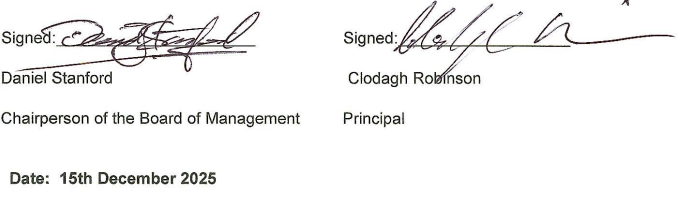
Ratification & Communication
Reference Section
- Assessment in the Primary School Curriculum – Guidelines for Schools, NCCA, 2007
- Special Educational Needs – a Continuum of Support, Guidelines for Teachers and Resource Pack for Teachers, NEPS, 2007
- Learning Support Guidelines, DES, 2000
- Understanding Behaviours of Concern and Responding to Crisis Situations Guidelines for Schools in Supporting Students, Department of Education,
- Circular 0138/2006 Supporting Assessment in Primary Schools
- Circular 02/05 Organisation of Teaching Resources for Pupils who need Additional Support in Mainstream Primary Schools
- Primary School Curriculum – section on assessment for each subject
- NCSE Relate, 2025
- Department of Education and Skills (2022). Looking at Our School 2022 A quality Framework for Primary and Special Schools.
- Department of Education (2024). Guidelines for Primary Schools Supporting Children with Special Educational Needs in Mainstream Classes
- Department of Education and Skills (2019). Wellbeing Policy Statement and framework for Practice
- Department of Education (2022) Autism Good Practice Guidance for Schools, Supporting Children and Young People gov.ie – Autism Good Practice Guidance for Schools – Supporting Children and Young People
- Dept. of Children and Youth Affairs (2017). Children First: National Guidelines for the Protection and Welfare of Children, Dublin. Stationary Office https://www.tusla.ie/uploads/content/Children_First_National_Guidance_2017. pdf
- Working together to Make a Difference for Children, NEPS https://assets.gov.ie/static/documents/national–educational–psychologicalservice–neps–information–for–parents.pdf
- A range of assessment tests are listed on the NSCE website (www.ncse.ie)
- Draft Report Cards Templates. www.ncca.ie
- info@ncca, September 2005. Issue 1, p. 8. Assessment for Learning
- Identifying Special Needs: Diagnostic Checklists for Profiling Individual Differences, 3rd Edition
- Circular 0030/2014
- Circular 0013/2017
- Circular 0054/2022
- Circular 0018/2023
- Circular 0081/2024
- Circular 0025/2025
- Circular 0032/2026
- Guidelines for Primary School: Supporting Children with Special Educational Needs in Mainstream Classes and Indicators of Effective Practice for Primary Schools.
- Educate Together Learn Together curriculum